
2 architectures to connect Shopify to the ERP
Connecting Shopify to an ERP involves correctly circulating the catalog, inventory, orders, shipments, and returns across all channels.
Today ~50% of merchants surveyed also sell in physical stores and 49% engage in B2B activities according to a study by the ICC. An error in reference, quantity, or status can affect customer service, warehouse preparation, and accounting data.
The search for the best ERP integration solutions for Shopify therefore begins with an architectural decision, rather than a ranking of software. The choice mainly revolves around 2 models: a direct integration between Shopify and the ERP, or a middleware that coordinates multiple systems.
Shopify remains an e-commerce platform, not an ERP. Each system retains a distinct responsibility : the ERP manages management data, the WMS executes physical movements, the OMS orchestrates orders and the TMS organizes transport and its tracking.
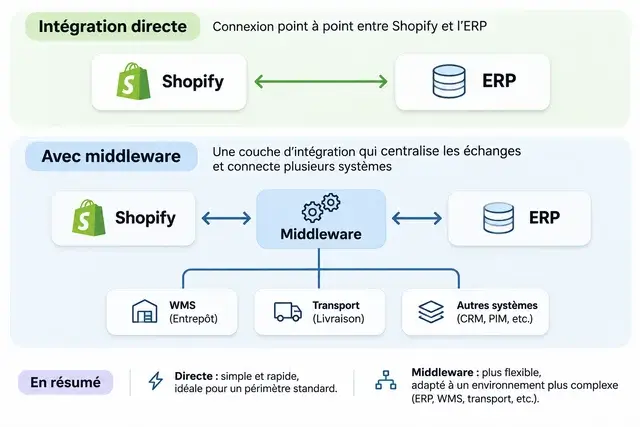
Direct Shopify–ERP integration
A direct integration can take the form of a connector published by the ERP vendor, a compatible application, or an API connection developed for both platforms. It limits the number of components when the flows remain close to the standard functions of the connector.
Synchronization can be event-driven, scheduled, or manual. Its frequency depends on the connector, the available APIs, and the validated rules. Therefore, the presence of a connection does not guarantee an instantaneous update.
In 2026, Shopify limits the amount of data that applications can request each second. This limit varies by subscription: 100 points for Standard, 200 for Advanced, and 1,000 for Shopify Plus. These points measure the complexity of requests, not their number. They can influence the speed of synchronization of inventory and orders with the ERP (source: Limits of Shopify data synchronization)
Traditional middleware
Middleware is a third-party layer that communicates with multiple systems. It transforms data, schedules exchanges, directs each message to its destination, and can centralize error processing. According to the 2026 Connectivity Benchmark Report by MuleSoft, large companies surveyed use an average of 957 applications, of which only 27% are connected.According to the same study, IT teams spend an average of 36% of their time designing, developing, and testing custom integrations.
This architecture provides extensive coverage when Shopify needs to communicate with multiple ERPs, marketplaces, or warehouses. It can also accelerate the configuration of existing connectors. In return, the business rules reside in a system separate from Shopify and the ERP, which adds an operational responsibility (presentation of the integration architectures) [1].
The criteria that determine the right choice
The choice must start from the scope of the connectors, the bidirectional synchronization, and the source of truth assigned to each data. It is also necessary to evaluate the accuracy of stock, returns, the transformations, error recovery, observability, migration, and the total cost of ownership.
A standard connector generally covers the catalog, the stock, orders, and processing statuses. Discrepancies often arise on customer-specific rates, contractual visibility of the catalog, backorders, and credit conditions managed in the ERP.
🎯Criterion
🔗 Shopify–ERP direct
🔀 Middleware
✅ Operational control
🎯Connectors
🔗 Scope focused on Shopify and the ERP
🔀 Possible coordination of multiple applications
✅ Check the supported versions, objects, and fields
🎯Bidirectional synchronization
🔗 Depends on the connector and configuration
🔀 Depends on the connectors and configuration
✅ Identify the direction of each flow
🎯Stock
🔗 Direct exchange possible
🔀 Consolidation possible between multiple sources
✅ Name the source of truth and the booking rules
🎯Orders and returns
🔗 Adapted to covered standard cycles
🔀 Orchestration of multi-channel cycles
✅ Test cancellations, partial returns and backorders
🎯Errors and monitoring
🔗 Depends on the connector and configuration
🔀 Potentially centralized monitoring
✅ Control logs, alerts and follow-ups
🎯Transformations
🔗 Often limited to the intended scope
🔀 Broader transformation rules
✅ Document formats, statuses and correspondences
🎯Scalability
🔗 Additional development possible
🔀 Addition of systems and routes possible
✅ Measure the effect of each new channel
🎯Migration and operational responsibility
🔗 Fewer components, connector dependency
🔀 Additional layer to migrate and maintain
✅ Designate the person responsible for each incident
Integration must cover the entire cycle. An order created in Shopify or the ERP must reach the WMS with the correct lines and reservations. The WMS must then return the shipment, tracking, and variances, as explained in this ERP integration guide.
Comparison by operational impact
Total cost and implementation effort
The financial assessment must include configuration, the mapping of data, testing, maintenance, licenses or consumption, incident management, and on-call duty. A low initial cost can mask a lasting manual effort if exceptions remain out of the scope. According to Ensono (2025), 49 % of IT managers surveyed have exceeded their budget for maintaining legacy systems. A cost to anticipate during an ERP integration.
A published connector often suits standard flows. A middleware becomes relevant with an old, heavily customized ERP or surrounded by many applications. A custom API integration requires ongoing support for errors, retries, monitoring, and updates. According to BCG (2025), 39 % of companies using multiple specialized software allocate more than 20 % of their IT budget to their integration, compared to 29 % for those using an integrated suite.
Reliability of inventory, orders, and returns
Teams must explicitly map product references, quantities, necessary prices, contact details, order statuses, reservations, shipments, tracking, and returns. Each data must have a named source of truth. A European study published in 2026 reveals that 64.7 % of analyzed references show a discrepancy between recorded stock and actual stock. This shows the importance of verifying the data exchanged between Shopify, the ERP, and the warehouse.
Tests must include a cancellation, a break, a partial return, a transmission failure, and a manual correction. They must also verify idempotence, meaning the ability to resend a message without creating duplicate orders or movements. According to DPD (2025), 36% of regular online shoppers in Switzerland report having returned their last package. This figure shows the importance of properly synchronizing returns.
Supervision, scalability and accountability
An API indicates that a technical exchange is possible. It neither proves the completeness of the flow, nor its frequency, nor the handling of errors. It is necessary to check the available events or webhooks, the synchronization schedules, the logs, and the recovery mechanisms (integration checkpoints).
Scalability also depends on governance. A person or a team must receive alerts, qualify the incident, resend the messages, and correct the data. This role must remain explicit when multiple providers are involved.
Switzerland–EU flows and multi-channel operations
Let’s take a Shopify store that sells in Switzerland and in the European Union with an ERP, multiple warehouses, a marketplace, and a return circuit. The architecture must allocate the available stock to the right channel, convert the expected formats, and keep track of status changes.
In this case, the number of systems, the transformations, and the expected traceability weigh more than just the Shopify–ERP exchange. E-commerce platforms can be connected to the WMS, OMS, and TMS through connectors and ERP solutions (e-commerce and logistics architecture).
Emaloja integrates WMS software, OMS systems, and automation technologies. This documented skill does not mean that an ERP or a given version automatically benefits from native compatibility.
Advantages and limitations of each approach
Direct Shopify–ERP integration: advantages and limitations
Advantages:
- It is suitable for standard exchanges covered by the connector.
- It reduces the number of components, technical contracts, and interfaces to govern.
- It simplifies diagnosis when the flow connects only Shopify to an ERP.
- A custom API allows precise control over the mapping and workflow logic.
- Limitations:
- Its scope depends on the objects, fields, and events covered.
- Specific B2B rules may require adaptations.
- An evolution of Shopify, the ERP, or their APIs may require maintenance.
- Custom development requires technical skills and ongoing monitoring (comparison of integration methods) [2].
Traditional middleware : advantages and limitations
Advantages:
- It transforms formats and data models between applications.
- It orchestrates multiple channels, warehouses, marketplaces and business tools.
- It can centralize logs, alerts, and recoveries.
- It allows adding a new flow without rebuilding all existing connections.
- Limitations:
- It adds a layer to configure, secure, supervise, and migrate.
- Distributed rules sometimes complicate the diagnosis of an incident.
- Its effectiveness depends on the actual coverage of each connector.
- The organization must assign the management of errors, updates, and returns.
With a third-party logistics provider, a connector or a middleware can complement the architecture if each responsibility is clearly assigned (models Shopify, marketplace, and fulfillment).
Verdict: choose based on the complexity of flows and operational capacity
Choose a direct Shopify–ERP integration when the ERP and WMS scope remains limited, when the flows correspond to standard functions, and when operational simplicity is paramount. This approach is particularly suitable if the connector already covers the necessary data, events, and exceptions.
Consider a middleware when multiple systems, channels, warehouses, or countries need to be orchestrated. It also becomes relevant when the data requires significant transformations or when the organization wants to centralize the supervision of exchanges.
No recommendation exempts from validating the technical compatibility, functional scope, and responsibilities. A demonstration of a nominal flow is not sufficient to establish the architecture's ability to handle daily incidents.
Before going live, check the following points:
- Identify each data point and its source system of truth.
- List the flows, their directions, and the exceptions to cover.
- Define the frequency or events that trigger synchronization.
- Check the logs, alerts, and error recovery.
- Assign the maintenance of each connector and business rule.
- Test the complete cycle with normal orders, cancellations, returns, breaks, and stock discrepancies.
The final choice therefore depends less on the name of the tool than on the company's ability to leverage it. The winning architecture maintains consistent data and explicit responsibilities between Shopify, the ERP, the WMS, the OMS, the TMS, and logistics partners.