
Prerequisites and signals that justify a change of 3PL
A successful 3PL migration maintains a defined reference source for inventory and order status. It assigns each task to a responsible person, then allows the switch after reconciling inventory and completing tests.
Several signals may justify a change: repeated discrepancies between theoretical and physical inventory, duplicated or untransmitted orders, delays in updating shipments, poorly managed returns, and undocumented preparation rules. Fragile integrations, the absence of formalized error handling, or difficulties with Switzerland–EU flows also reinforce the need to act.
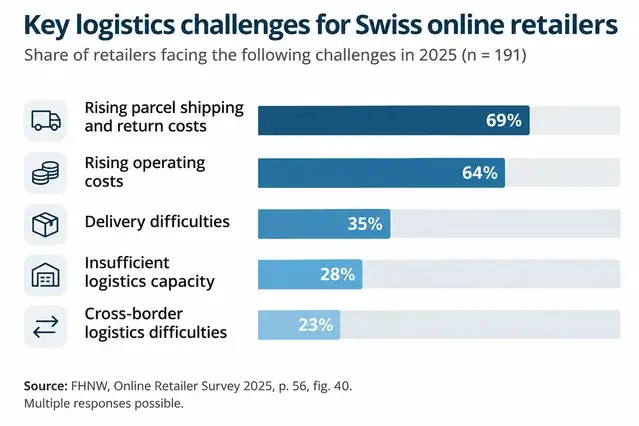
35% of Swiss merchants face delivery difficulties. 28% of them report capacity issues and 23% of them encounter cross-border difficulties according to Handelsverband.
Before setting a date, check the conditions for termination, the notice period, stock exit clauses, exportable data, and closing invoices. The notice period can be up to 90 days according to the contract. Therefore, this is a contractual condition to check, and not a general rule.[1].
Gather the following prerequisites:
- a business sponsor and a single project manager;
- access to systems and usable exports;
- designated contacts at both 3PLs;
- a separate test environment ;
- a reference inventory ;
- change freeze rules ;
- an approved rollback procedure.
The expected outcome is a controlled scope before any termination or intervention on the stock.
Step 1 — Audit the existing architecture and the flows to preserve
List the inventory of systems involved in order processing: ERP, OMS, WMS, Shopify or WooCommerce store, marketplaces, carrier tools, customer service, and returns portal. The OMS manages order orchestration, while the WMS drives operations in the warehouse.
In 2025, 22% of surveyed merchants plan or are considering changing their ecommerce platform: 12% have a concerted project and 10% are thinking about it according to a Handelsverband survey. 30% of them express some dissatisfaction with their current platform.
Then map the complete cycle: order creation, payment control if necessary, allocation, preparation, shipping, tracking, cancellation, partial shipment, backorder, return, restocking, and adjustment.
For each data point, indicate :
- the reference system ;
- the synchronization direction ;
- the triggering event ;
- the update frequency ;
- the priority in case of conflict ;
- the functional owner.
The mapping must cover the SKU, the description, the lot, the serial number, the expiration date, the quantity, the location, and the stock status. Add the order and return statuses, tracking as well as the adjustment reason. This method is particularly useful for the traceability of lots and serial numbers.
Connecting an ERP to an outsourced warehouse also requires an explicit functional distribution. The ERP can maintain the business rules, while the WMS carries the operational statuses of the stock. This distribution must be decided before the development of the interfaces, without being considered universal.
Step 2 — Establish the governance, responsibilities, and migration schedule
Organize the schedule by milestones. The actual dates depend on the contract, volumes, interfaces, and customs constraints.
◷ Step
▤ Deliverable
◉ Responsible
✓ Validation
◷ Contractual preparation
▤ Exit clauses, notice, and return terms validated
◉ Merchant
✓ Exit conditions accepted
◷ Framing
▤ Scope, responsibles, and decision rules documented
◉ Project manager
✓ Governance approved
◷ Audit and cleanup
▤ Mapping and corrected data
◉ Merchant
✓ Critical discrepancies addressed
◷ Configuration and testing
▤ Configured interfaces and validated scenarios
◉ Emaloja and IT teams
✓ No open critical defects
◷ Initial physical transfer
▤ Stock shipped, received, and counted
◉ Outbound 3PL and STAR Logistique
✓ Reconciliation accepted
◷ Controlled operation
▤ Limited routing and active monitoring
◉ Merchant
✓ Validated operational flows
◷ Switch
▤ New site activated per formal decision
◉ Switch responsible
✓ Entry criteria met
◷ Stabilization
▤ Closed discrepancies and accepted operation
◉ Merchant
✓ Transition to normal regime
The responsibility matrix assigns each migration task to an identified primary responsible person.
▣ Task
◉ Responsible
▣ Switch decision
◉ Merchant
▣ Data export
◉ Outbound 3PL
▣ Starting inventory
◉ Outbound 3PL
▣ Pallet preparation
◉ Outbound 3PL
▣ Receiving and counting
◉ STAR Logistique
▣ Interface configuration
◉ Emaloja
▣ Interface and flow testing
◉ Emaloja
▣ Order routing
◉ Emaloja
▣ Client information if necessary
◉ Merchant
▣ Triggering rollback
◉ Merchant
▣ Final validation
◉ Merchant
The merchant decides on business rules and validates the results. The outbound 3PL prepares the data and stock to be returned.STAR Logistique handles the agreed physical operations of receiving, storage, preparation, shipping, returns, and customs coordination.
Emaloja acts as a digital integration partner between ecommerce, ERP, WMS and data flows. The framework must specify the exchanged data, the exceptions, and the distribution of responsibilities before any connection.
Step 3 — Prepare and validate stock, order, and return data
Create a master migration file. It must contain the canonical SKUs, barcodes, sales and preparation units, dimensions, weight, packaging rules, and kit composition. Add sellable availability, reserved, blocked, and damaged stock, as well as batches, serial numbers, expiration dates, and original locations.
For your information, 76% of surveyed consumers cite better product availability among the reasons for favoring large marketplaces according to the Post.
Match each line between the ERP, the outgoing WMS, the sales channels, and the transfer file. Classify discrepancies, document their cause, then correct them or place the affected units in quarantine. Clearly separate allocated, available, blocked, under inspection, or damaged units. Also identify ongoing transfers and restocks.
Keep a separate record of open orders. For each, log the lines, quantities prepared or shipped, the carrier, the customer promise, the relevant payment status, the processing decision, and the responsible warehouse. An open fulfillment task should only belong to one warehouse.
Formalize often implicit rules: preparation priorities, allowed substitutions, kits, branded packaging, quality controls, returns, restocking, and anomalies.
Use this checklist before the transfer :
- timestamped export and validated identifiers ;
- initial physical count ;
- confirmed lot and series rules ;
- open orders inventoried ;
- return address and carrier accounts verified ;
- labels and customs documents available ;
- technical access tested.
The expected result is a consistent base that allows for reconciling stock and open orders before their movement [2].
Step 4 — Choose a risk-appropriate transition strategy
Choose the strategy based on the criticality of the orders, the volume, stock depth, and the quality of SKU identifiers. Also assess the maturity of interfaces, site routing, lot or series constraints, and the ability to manage a temporarily more complex operation.
◈
Strategy
▤
Principle
✓
When to use it
⚠
Risks
◉
Selection criteria
◈
Complete
transition
▤
Transfer
of the entire scope on a given date
✓
The
scope is controlled and the interfaces are validated
⚠
Temporary
unavailability, counting discrepancy, difficult recovery
◉
Ability
to validate all stock before activation
◈
Gradual
migration
▤
Sequential
transfer by SKU, channel, region, or order group
✓
Flows
can be isolated with reliable identifiers
⚠
Incorrect
routing, fragmented visibility, divergent rules
◉
Ability
to separate and bring together each wave
◈
Parallel
operations
▤
The
2 sites operate according to explicit rules
✓
Multi-warehouse
routing is reliable
⚠
Double
processing, poor allocation, misdirected return
◉
Ability
to assign each order to a single site
The complete switch focuses operations on a coordinated change. The gradual migration facilitates group validation and targeted rollback. Parallel operations keep 2 sites active, increasing control needs.
Contextualize each method according to the project, without imposing a standard duration. The truck leaving the outgoing site is never a sufficient criterion. Stock becomes sellable in the new WMS only after its receipt, counting, and acceptance of reconciliation.
Step 5 — Connect ERP, ecommerce channels, and the new WMS
Choose the appropriate exchange mechanism. An API automates the exchanges according to the functions that the systems expose. EDI transmits structured documents compliant with the requirements of certain partners. A middleware transforms, orchestrates, and monitors messages between heterogeneous systems.
The choice depends on the available formats, the volume of updates, the level of automation sought, and the team's ability to manage imports and incidents. Shopify imposes certain limits on its APIs depending on the subscription type (see the official limits of the Shopify API). WooCommerce, on its side, allows that a webhook can be automatically disabled after 5 consecutive failures of delivery.
Define a stable key for each order, line, SKU and logistics event. Apply an idempotence rule: when a system receives the same event multiple times, it must not create a second order or additional stock movement.
Document exchanges in both directions:
- product and availability ;
- reservation and order ;
- cancellation and allocation ;
- preparation, shipping and tracking ;
- delivery when this information is available ;
- return and adjustment.
Plan for error logging, acknowledgments, controlled attempts, alerts, and authorized manual interventions. Add a daily reconciliation and an escalation assigned to a named person.
Ecommerce order integration with a 3PL provider must start with defining data, exceptions, and responsibilities. These rules precede the connection of Shopify, WooCommerce, or Odoo to a 3PL.
In this scope, Emaloja connects ecommerce channels, the ERP, the WMS, and associated flows. Products, quantities, coordinates, and instructions are transmitted to the WMS, then logistics data returns to the relevant channel. The frequency and available events remain to be validated for each project.
Step 6 — Test end to end before any customer order
Run tests in a separate environment. Clearly identify the test products, customers, and orders. For each scenario, document the expected result, the observed result, the anomaly, its owner, and the authorization for production.
Test at a minimum :
- a simple order and a multi-line order ;
- a partial preparation, a break and a remainder ;
- a cancellation before and after allocation ;
- an address modification according to the agreed rule ;
- a shipment in multiple packages and the transmission of tracking ;
- a return, a restocking and an adjustment ;
- an order from a marketplace ;
- an authentication error and an unknown SKU ;
- insufficient stock ;
- a duplicated event or received out of order ;
- a failed synchronization, then resumed.
Check each scenario in the sales channel, the ERP or the OMS, the WMS, the carrier tool and the returns portal. An accepted technical message is not enough. Check the final stock, the displayed status, the generated documents and the operational routing.
During parallel operations, run a non-regression test on the outgoing site. It must confirm that the new rules do not redirect an already allocated order.
The exit criterion is clear: no critical anomaly remains open on stock, order, shipment, cancellation, return or recovery after failure. If a synchronization is presented as immediate, check precisely its frequency and the supported events.
The expected result is an end-to-end validated chain, with actionable proof for each scenario.
In 2025, 22% of merchants report having average or significant difficulties with order processing and 27% with return processing according to a FHNW study.
Step 7 — Organize the physical transfer, stock reconciliation, and Switzerland–EU flows
Treat the transfer as a coordinated physical project. Start with a timestamped starting count and a reference extraction. Then reserve the stock in transfer, plan the collection, label the pallets, and confirm the receiving slot.
Upon arrival, check the units, perform the receiving count, and reconcile discrepancies. Only an explicit decision allows the transition to sellable status.
Transfer traceable products by batches, serial numbers, and original expiration dates. When the project allows, the receiving checks these identifiers by scanning the barcodes [3].
Isolate the categories that follow a different cycle:
- stock in transit or reserved;
- packages shipped but not delivered;
- returns in transit;
- damaged goods;
- expected restocks.
Switzerland is outside the customs union of the European Union (see the new 2026 Passar declarations). For a transfer between the EU and Switzerland, assign the declaration responsible, the reference importer, the documents, the tariff codes, and the stock status during transit. Have the obligations specific to the goods validated by the competent customs and tax contacts.
27.4 million tons of goods were imported from the EU by road in 2024 according to a report from the Federal Department of Foreign Affairs.
STAR Logistique carries out the agreed physical operations, including receiving, storage, preparation, shipping, returns, and customs coordination. Emaloja maintains the digital perimeter of flows and interfaces.
Read our guide France-Switzerland for cross-border ecommerce logistics.
Step 8 — Execute the production rollout with switch and rollback criteria.
Set a single switch time, a list of reachable stakeholders, and a decision-maker for each action. Choose a time slot that is compatible with the available support capacity and the business constraints specific to the company.
Execute the following list in order:
- validate received and active stock;
- close or direct open orders;
- freeze any relevant catalog and rule changes;
- activate the routing to the new site;
- monitor the arrival and processing of the first orders;
- complete the remaining orders with the outgoing 3PL;
- confirm the routing of returns;
- update the synchronization rules and channel statuses.
Only allow the switch if counts are accepted, the interfaces tested, and test orders successful. Also confirm the access, support, exception rules, and documentation from the responsible parties.
The rollback procedure must specify its conditions for triggering and the person who authorizes it. It explains how to deactivate or reverse routing, process queued orders, and inform the teams. It finally requires a reconciliation of the transactions created during the incident.
The expected result is a reversible decision, based on observable elements rather than just the date on the schedule.
Step 9 — Stabilize operations and monitor post-migration indicators
Define a stabilization phase with an agreed-upon monitoring frequency. For each indicator, specify the source system, the owner, the internal alert threshold, the corrective action, and the review frequency.
Monitor in particular:
- the accuracy of stock by SKU and by status;
- the orders transmitted, processed, duplicated, or in error;
- the correction time for synchronizations;
- the correct preparation, partial shipments, and backorders;
- the missing follow-ups;
- the returns received and restocked;
- the inventory discrepancies to investigate.
Regularly reconcile the 3PL stock with the warehouse balance in the ERP. Document each difference with its cause, for example, a shipment not reported, a return in transit, or unreported damage. This control is part of the practices for reconciling outsourced stocks.[4].
Return to normal operations after closing critical discrepancies, accepting the returns process, and confirming that the 3PL outbound no longer receives unplanned tasks.
In 2025, 35% of merchants consider customer service requests as a medium or significant challenge (up from 31% in 2024) according to FHNW.
Illustrative example — A French distributor transfers its stock to a Swiss warehouse
A French distributor sells in Switzerland with Shopify and a marketplace. Its ERP retains the business data. It wishes to transfer its stock from an existing 3PL to a Swiss warehouse.
The team first audits the SKUs and open orders. It designates the WMS as the source of the operational statuses of the stock. This decision does not change the role of the ERP for business rules.
The distributor chooses a phased migration of selected SKUs. Orders already allocated remain with the outgoing 3PL. The team specifically tests cancellation and partial shipping before allowing a limited routing.
STAR Logistique receives and counts the goods expected within the agreed scope. The distributor compares the results with the transfer file, then validates availability. Emaloja orchestrates the interfaces between the ERP, Shopify, the marketplace, and the WMS. Routing is extended after validation of exchanges and reconciliation.
Before the departure of goods from the European Union, documentary and customs responsibilities are assigned. The distributor arbitrates the rules and validates the results, while each partner retains a distinct role.
Tips to reduce the risk during the transition
- Assign a single owner for each flow.
- Version the routing rules and keep the reference exports.
- Trace each exception decision with its author.
- Always distinguish between physical stock and sellable stock.
- Control the initial production events in all systems.
- Maintain an approved manual processing capacity.
- Keep order and SKU identifiers consistent between the ERP, channels, and the WMS.
These practices facilitate reconciliation and limit double processing. They are particularly useful when a provider of WMS integration solutions for ecommerce in Switzerland operates across multiple systems and channels.
Common errors to avoid during a 3PL migration
- Announcing termination before checking the clauses can block the exit. Validate the contract first.
- Moving stock before reconciliation makes discrepancies difficult to attribute. Compare sources before departure.
- Activating stock before its receipt creates a fictitious availability. Wait for the confirmed count.
- Simultaneously modifying catalog, pricing, and routing complicates analysis. Freeze unnecessary changes.
- Allowing 2 warehouses to process the same order causes duplicates. Assign each task to one site.
- Forgetting returns creates stock without a destination. Define their address and handling.
- Neglecting lots, series, or blocked stock destroys traceability.
- Ignoring synchronization errors skews the statuses.
- Omitting the owner of the return delays the decision.
- Using inconsistent SKUs or barcodes compromises the transfer. Correct their matching before any movement.
Expected results after the migration
At the end of the stabilization, the stock is reconciled and traceable. The availability rules are explicit, each order belongs to a single site, the interfaces are monitored and returns follow a defined routing. Responsibilities and the return procedure remain documented.
The objective goes beyond connecting a new WMS. The migration must maintain continuity between the ERP, ecommerce channels, order processing, the warehouse, and delivery. The next step is to integrate these controls into normal operating procedures.