
Prerequisites: frame the France-Switzerland project before connecting the systems
A European company can sell directly to Swiss individuals while supplying resellers. These 2 activities sometimes use the same products, but they follow distinct commercial, logistical, and documentary rules.
Online purchases from foreign merchants amount to 2.8 billion CHF and are increasing by +8% year on year according to Handelsverband.
The spending of Swiss consumers on online purchases is 15.8 billion CHF in 2025, also according to Handelsverband.
Before connecting the site, the ERP, and the warehouse, decide:
- the assortment allowed in each country;
- the countries, languages, and currencies served;
- the relevant B2C and B2B channels;
- the entity acting as the importer;
- the applicable Incoterms;
- the pricing and VAT policy (from 100,000 CHF/year. Source: AFC) ;
- the service levels by channel;
- the return rules and addresses;
- the essential article data;
- the responsibilities of internal and external teams.
Switzerland is not part of the European Union. Any movement of goods between France and Switzerland therefore constitutes a cross-border customs flow. Swiss rules should not be equated with those of the EU.
The declaration of commercial goods must be available at the latest when they are introduced into the Swiss customs territory. The official checklist for import details the relevant information and documents [1].
The scenario followed in this guide is that of a European distributor of non-perishable products. It operates a B2C shop and a portal reserved for Swiss resellers. Its stock architecture must be chosen jointly by the commerce, finance, IT, and operations teams, as it determines taxation, responsibilities, and order fulfillment.
Step 1: choose the stock architecture and the import model
Evaluate the frequency of Swiss orders, the predictability of demand, the expected lead time, returns, B2B deliveries by parcel or pallet, stock control, and the customs burden.
For a parcel coming from the EU, Swiss Post usually charges 13 CHF in customs clearance fees, plus 3% of the value of the shipment. However, these fees generally do not apply when the import VAT does not exceed 5 CHF. For example, a parcel worth 50 CHF, including shipping, is normally exempt from VAT and customs clearance fees. Consult the official rates.
Swiss customs duties on industrial products have been removed since January 2024. This measure does not eliminate the import declaration or other applicable obligations. Commercial goods may still be subject to VAT (8.1% in Switzerland), to royalties or rights according to their tariff number, their quantity, their weight, their value, and their origin.
The free trade agreement between Switzerland and the EU must be examined according to the goods and their origin. It does not create an automatic exemption, and agricultural products fall under different provisions.
Namely that a certificate of origin indicates where a product actually comes from, and not just the country of shipment. It is generally no longer necessary to import industrial products into Switzerland, but may remain useful in case of re-export.
▣ Model
✓ Advantages
⚠ Constraints
◈ Costs
◎ Use case
▣ Stock in France
✓ Consolidated stock and simpler assortment to manage
⚠ Formalities for each cross-border flow, management of Swiss returns and timing depending on transport
◈ Downstream transport, customs, import VAT, preparation, returns
◎ Swiss demand in testing phase or limited assortment
▣ Stock in Switzerland
✓ Local availability for B2C and B2B replenishments
⚠ Upstream import, immobilization and governance of Swiss stock
◈ Transport, customs, import VAT, stock, preparation, local delivery
◎ Predictable demand, local return or necessary Swiss availability
▣ Dual location France–Switzerland
✓ Assignment of references and orders to the appropriate site
⚠ Allocation, transfers and stock data more complex
◈ All previous positions, transfers, and multi-stock management
◎ Differentiated assortment or sustainable B2B and B2C needs
1. Centralized stock in France
Keep the stock in France to launch a controlled assortment. Define who exports, who imports, and the data transmitted to the declaring party.
2. Stock located in Switzerland
Import the stock upstream and prepare from Switzerland. Document the legal owner of the stock, the importing entity, and the commercial availability after customs clearance.
3. Dual location France–Switzerland
Reserve the Swiss stock for regular references or the needs of resellers. Less demanded products can remain in France.
For the chosen scenario, start from France with a limited assortment. Then supplement with Swiss stock when the availability, local returns, or B2B replenishment justifies it. The final decision must specify who imports, where each stock is held, and which site prepares each type of order.
Step 2: define the roles of the site, ERP, OMS, WMS, and transport
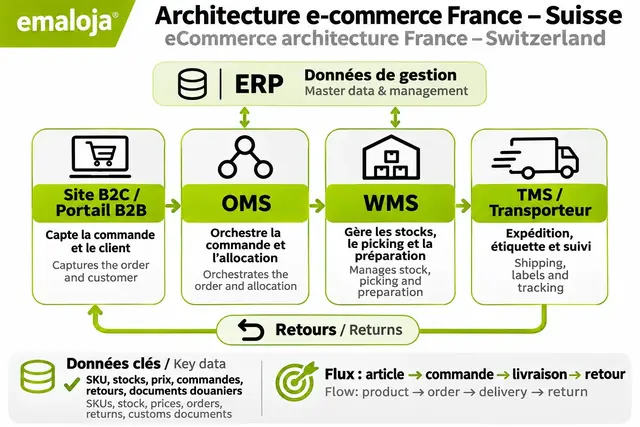
2.1 Separate the responsibilities of the systems
Assign a main function to each layer:
- The B2C site or B2B portal captures the order and customer information.
- The ERP retains the management data chosen by the company.
- The OMS coordinates the order cycle between channels and applies the allocation rules.
- The WMS executes receiving, stock movements, picking, and preparation.
- The TMS or carrier handles shipping, labeling, and tracking.
This target architecture must be compatible with existing software, contracts, and workflows. Connectors or API integration solutions can link the e-commerce platform to the WMS, OMS, TMS, and ERP. Only describe inventory synchronization as “real-time” after you have validated the frequency, trigger events, and behavior in the event of a failure.
Manage the SKUs, variants, B2B sales units, available and reserved stocks, prices by account, orders, statuses, packages, returns, commercial documents and customs data.
Target flow : creation or update of the item in the ERP → publication on the B2C site and the B2B portal → order → OMS → WMS → preparation → customs file if necessary → transport → tracking → return.
Pour approfondir la mise en œuvre d’un système connecté, consultez ce guide consacré à la Supply Chain Integration.
2.2 Design the flow of B2C and B2B orders
Set up B2C around payment, availability, delivery choice and communications to the end customer. Specify the moment when stock is reserved, then released after a cancellation or a refused payment.
The B2B portal must recognize authorized accounts, assortments and contractual rates, order units and validated addresses. Apply credit controls or approval circuits defined by the company.
The journeys share the item reference and the calculated availability, but must create identifiable orders. The OMS and the WMS can thus apply the planned rules.
2.3 Establish the matrix of responsibilities
Emaloja est l’agence numérique du groupe RDV SA, STAR Logistique, une entreprise de transport et de logistique basée à Genève. Emaloja peut intervenir sur la conception du site, les parcours B2B et B2C, les intégrations et l’architecture de données. STAR Logistique intervient uniquement sur les opérations physiques convenues par contrat.
Adapt this matrix to the chosen import model :
▣ Activity
◉ Seller
◈ Emaloja
▤ STAR Logistics
⇄ Transport / Customs
▣ Item management
◉ Owner and approver
◈ Architecture and integration if retained
▤ Control of necessary logistics data
⇄ —
▣ Order taking
◉ Defines business rules
◈ Designs the journey and exchanges
▤ —
⇄ —
▣ Availability stock
◉ Defines exhibition rules
◈ Configures the exchanges if retained
▤ Records the contracted movements
⇄ —
▣ Reception
◉ Provides the notice and documents
◈ —
▤ Physical reception if contracted
⇄ Delivers the transport information
▣ Preparation
◉ Defines B2B and B2C rules
◈ Transmits the instructions if integrated
▤ Executes the contracted preparation
⇄ —
▣ Shipping documents
◉ Validates the commercial content
◈ Organizes the necessary data
▤ Produces the agreed operational documents
⇄ Issues the documents relevant to its role
▣ Customs formalities
◉ Designates the importer and provides the supporting documents
◈ —
▤ Handles the formalities if contracted
⇄ Declares according to the mandate
▣ Delivery
◉ Defines the expected service
◈ Transmits the delivery choice
▤ Delivers the shipment to the agreed network
⇄ Transports and provides tracking
▣ Returns
◉ Defines the acceptance and business decision
◈ Configures the digital flow
▤ Receives and checks if contracted
⇄ Transports the return
▣ Handling of anomalies
◉ Decides and coordinates
◈ Correct Digital exchanges
▤ Handle physical anomaly
⇄ Handle customs or transport incident
Step 3: organize the receipt, customs clearance, and restocking between the 2 countries
3.1 Prepare the import file
Start with a shipping notice containing the references, quantities, logistical units, and expected dates. Cross-check this information with the contract, invoice, tariff classification, and proof of origin when relevant.
Determine the importer before departure. The contract, the invoice, the declaration, and the stock movement must consistently identify the parties. Have the tax and customs scheme validated by the competent specialists according to the goods involved.
Import VAT is generally collected by the Swiss customs administration. The normal rate has reached 8.1% since January 1, 2024 [2]. A reduced rate of 2.6% applies to certain goods, including food products, non-alcoholic beverages, medicines, newspapers, and magazines.
The base generally includes the invoiced price and the fees accumulated up to the destination in Switzerland. Provide a proof of value, such as an invoice or sales contract, to customs.
The replacement of e-dec Import by Passar Import started in 2026. The 2 systems will operate in parallel until September 30, 2027. Check the applicable system at the time of the flow and the procedures used by the declarant.
3.2 Receive and make the stock available
Upon arrival, check the references, quantities, condition of the goods and the documents. Record discrepancies in quantity, damages, and products pending quality control separately.
The WMS then places the goods in a suitable location. It should only publish availability after the required checks and confirmation of customs status. Therefore, a physical receipt does not automatically mean that the product can be sold.
Keep tax decisions, invoices, and evidence related to the movement. Electronic archiving must maintain the link with the transactions and ensure the readability of documents, in accordance with the rules related to ecommerce regarding VAT.[3].
Expected result: the received quantity, the usable quantity, and the blocked quantity are distinct in the systems.
Example: a distributor ships 500 units from France to its Swiss warehouse. Upon receipt, 480 are compliant, 15 are damaged, and 5 are missing. The WMS only makes the 480 validated units available. The other 20 remain blocked or are under verification, without increasing the sellable stock.
3.3 Replenish without desynchronizing the channels
Set the replenishment thresholds, safety stock, and the frequency of transfers between France and Switzerland. Also identify the owner of the stock during transport and the system that carries this status.
Treat stock in transit as a separate category. Do not add it to the sellable stock until its receipt is confirmed. If the quantity received differs from the expected quantity, block the discrepancy and open an investigation rather than silently correcting the stock.
In the distributor scenario, the references regularly ordered by resellers can supply the Swiss stock. The less demanded items remain in France. This distribution protects the B2B allocation while limiting unnecessary duplication of the assortment.
Example : a Swiss distributor sells on average 20 units per day. Restocking from France takes 4 days and their safety stock is set at 40 units. Therefore, they must initiate a new transfer when their projected available stock reaches 120 units (20 × 4 + 40), taking into account the orders and receipts already planned.
Step 4: execute the orders, deliveries, and B2C and B2B returns
4.1 Prepare and ship the B2C orders
Process a B2C order in the following order:
- Validate the payment or required authorization.
- Check and then reserve the availability.
- Forward the order to the fulfillment site.
- Perform the picking and verify the reference.
- Pack according to the product and chosen transport.
- Produce the label and required documents.
- Send the tracking and scheduled notifications.
Set a priority rule when B2C and B2B request the same SKU. The OMS can reserve a quantity by channel or apply an allocation rule, provided that this rule is explicit and tested.
In case of delivery failure, retrieve the status of the carrier. Then decide on a new presentation, a return, a refund, or customer contact according to the business policy.
According to the Barometer of e-commerce 2026 from Swiss Post, 75% of surveyed consumers attach importance to package tracking and 69% to notifications before delivery. Tracking and delivery information must therefore be accessible to the customer from the time of shipment.
4.2 Supply the Swiss resellers
First, validate the account, address, terms of sale, and any credit approval. Prepare according to the agreed sales unit, such as the box, batch, or pallet, without automatically converting the order into B2C units.
Consolidate the lines if the order or transport requires it. Add the delivery note, reseller references, and applicable commercial documents. Organize an appointment or time slot when the destination site requires it, then keep the proof of receipt.
Every shipment between France and Switzerland, in either direction, requires declarations and supporting documents appropriate to the shipment and its destination. The terms and conditions, carriers, pickups, and delivery times must comply with the ecommerce delivery contract.
In the scenario, the Swiss B2C order comes from the stock designated by the allocation rules. The reseller's replenishment follows its order units and B2B documents.
4.3 Manage returns and exceptions
Set a return address for each country and each channel before launch. Communicate the acceptance criteria as well as the information that the customer or reseller must include.
Upon receipt, identify the return and check its condition. Then assign it to sellable stock, quarantine, or the processing planned by the company. Trigger the credit or refund only after the defined check.
A cross-border return may modify the customs and accounting documents. Therefore, link the initial shipment, the return authorization, the physical movement, and the financial decision in the systems.
Return France–Switzerland : when an imported product in Switzerland is returned to the French seller, some import taxes may be refunded under certain conditions. Keep the initial import declaration, the return reference, and the proof of reshipment to allow for this verification.
Step 5: test, launch and manage the integrated solution
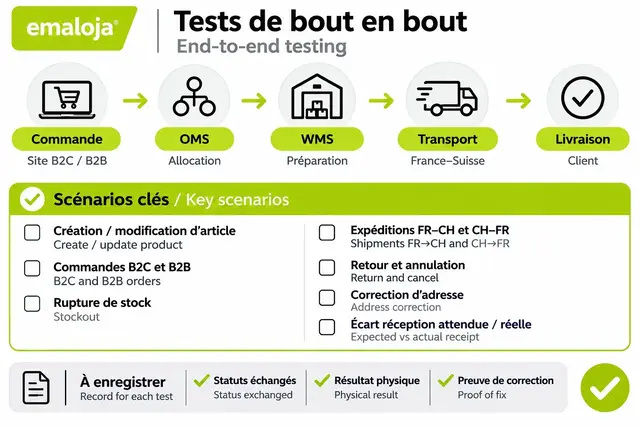
5.1 Conduct end-to-end testing
Test complete scenarios rather than each application separately. Cover the creation or modification of items, B2C and B2B orders, stockouts, shipments from France to Switzerland and from Switzerland, the return and cancellation.
Add address correction and the discrepancy between expected and actual receipt. Keep for each test the exchanged statuses, the physical result, and the proof of correction.
5.2 Use the launch checklist
Data and business rules
☐ Data owners are designated.
☐ B2B prices and units are validated.
☐ The stock status exposed by channel is defined.
☐ Documents and rules by country are approved.
Integrations and security
☐ Error scenarios are tested.
☐ User accesses are controlled.
☐ Mappings and exchange logs are available.
☐ Manual recovery is documented.
Warehouse, customs, and transport
☐ The documents for each flow are validated.
☐ The import and declaration roles are confirmed.
☐ The B2B and B2C rules are recognized at the warehouse.
☐ Returns and delivery failures are tested.
Support, monitoring and governance
☐ The validation roles are assigned.
☐ The escalation contacts are known.
☐ The exceptions have an owner.
☐ The test evidence is accepted.
Allow the launch when the teams know how to handle exceptions. The correct display of the site is not enough to demonstrate that the chain is functioning.
5.3 Track the initial operational discrepancies
Organize a regular review of blocked orders, stock discrepancies, pending shipments, customs anomalies, returns, B2B claims, and rejected product data.
Choose indicators suitable for the activity: stock accuracy, order processing, integration incidents, operational anomalies, and data quality. Assign each discrepancy to a responsible person and keep the cause as well as the correction.
Example: out of 200 B2B and B2C orders, 12 are blocked: 5 for a stock discrepancy, 4 for an address error, and 3 for an ERP–WMS synchronization issue. The blocked order rate reaches 6%. This tracking allows addressing recurring causes rather than correcting each order separately.
Tips and best practices for sustainable France–Switzerland operations
- Designate a source of truth for each data point. The ERP can hold the management data, while the WMS holds the physical movement, depending on the chosen architecture.
- Separate B2B and B2C rules. Accounts, prices, sales units, documents, and delivery terms should not depend on a manual correction at the warehouse.
- Version the mappings between SKU, variants, statuses and shipping codes. A modification must be dated, tested, and reversible.
- Explicitly identify stock in transit. Determine when it leaves a site, when it becomes available, and who handles a discrepancy.
- Document the person responsible for each exception. Include cancellations, breaks, invalid addresses, customs rejections, and unidentified returns.
- Regularly audit classifications, origins, values, and customs documents.
- Localize content, prices, currencies, means of payment, and delivery terms according to the target market. Select each option based on actual needs, without assuming that one platform or means of payment fits all.
- Start with a controlled scope of assortment, of channels and flows. Then expand the dual implementation or integrations.
- Test returns, cancellations, adjustments, and unavailability. The ideal flow does not reveal the main operational challenges.
These practices apply to various ecommerce platform solutions in France and Switzerland. They also make it possible to evaluate an ecommerce and logistics service provider in Switzerland based on specific responsibilities.
Common errors and troubleshooting of cross-border flows
Incorrect displayed stock or blocked order
Compare the unit of measure, SKU, reservations, cancellations, and stock in transit. An incorrect mapping or an unreleased reservation often explains the discrepancy. Temporarily block the affected sale, correct the source data, and then replay the controlled exchange.
Inconsistent customs file
Check the consistency between the goods, the value, the origin, the classification, the invoice, and the role of the importer. The imported commercial goods must be declared in writing or electronically to the Swiss customs. Suspend the shipment and have the documents corrected by the responsible party before any new submission.
B2B order prepared as a B2C order
Check the channel, the account, the preparation unit, the price, the address, and the delivery method transmitted to the WMS. The cause may be an absent order type or a common allocation rule for the 2 paths. Stop the preparation, restore the B2B instructions, and check the other orders from the same batch.
Return without processing or restocking
Look for the link between the return authorization, the package received, and the initial order. Immediately assign the product to the designated status: sellable stock, quarantine, or destruction according to internal rules. Then record the decision in the WMS, OMS, and the relevant financial system to avoid inconsistent availability or refunds.
Expected results after the launch
After the launch, the company has an explicitly chosen stock architecture. It knows where the goods are held, who imports them, and which site fulfills each order.
Responsibilities between the site, the ERP, the OMS, the WMS, the warehouse, and transportation are documented. Article data, stocks, orders, statuses, documents, and returns follow controlled flows. The operations distinguish the execution of a B2C order from the restocking of a reseller.
In the following scenario, the distributor now knows which warehouse serves each order, which system is authoritative, and who handles each exception. End customers receive communications specific to B2C, while resellers obtain their order units, documents, and B2B conditions.
Formalize the target architecture and the responsibility matrix before launching developments or operations. This decision provides a common foundation for the commerce, IT, finance, and supply chain teams.
Emaloja provides services in digital architecture, e-commerce platforms, and integrations. STAR Logistique handles the agreed-upon physical operations, including warehousing, order fulfillment, customs clearance, and transportation. Emaloja’s cross-border services also include customs clearance, tax representation, and business registration, depending on the project.